
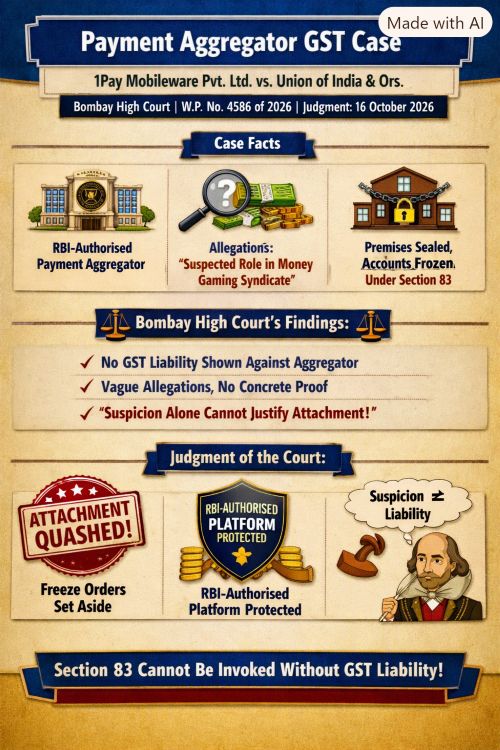
Section 83 GST – Attachment of Bank Account of Payment Aggregator
Judgment dated 16.10.2026 of the High Court of Bombay in Writ Petition No.4586 of 2026 (OS) of 1Pay Mobileware Private Limited Vs. Union of India and others
the case of the respondents against the petitioner is that though the petitioner claims to be a payment aggregator, they may be playing a significant role in the alleged evasion of GST by an organised online money gaming syndicate. The petitioner has failed to cooperate with the investigation and it was found that the Principal Place of Business (PPOB) and the Additional Place of Business (APOB) of the petitioner were found locked. No documents were found at the business premises despite the statutory requirement to maintain records and the server was found empty. This reveals that the petitioner’s role may extend beyond that of a payment aggregator and that the petitioner may be playing a significant role in the alleged evasion of GST by an organised online money gaming syndicate.
On 14th May 2024, RBI issued a certificate of authorisation to operate as an online Payment Aggregator to the petitioner company. RBI further issued a certificate of authorisation dated 23rd June 2026 to operate as both an online and offline Payment Aggregator to the petitioner. On 9th August 2026, the HR of the petitioner sent an email to its employees informing them to work from home due to shifting of the office. On 10th August 2026, the respondent No.2, without any prior intimation, sealed the premises of the petitioner situated at Kurla (West), Mumbai.
By the notice dated 10.8.2026 of the respondent no.2, the bank accounts of the petitioner company were provisionally attached.
The case of the respondent No.2 relates to the allegation of money laundering by unnamed third parties. There is no whisper of any GST liability of the petitioner. As indicated earlier the stand of the respondents is that there is a suspicion that the petitioner’s role may extend beyond that of a payment aggregator and that they may be playing a significant role in the alleged evasion of GST by an organised online money gaming syndicate. The matter is under investigation. 22. The petitioner is a payment aggregator authorised by the RBI. It operates a payment platform similar to Google Pay / PhonePe. Third party merchants/sellers and their customers (buyers) use the platform only for the purpose of making online payments which are only through banking channels. The entire money received from online purchasers is directly received in the escrow account that is mandated by the RBI. It is the submission of learned Senior Advocate for the petitioner that the money does not belong to the petitioner. The petitioner only receives a commission. The third-party merchants/sellers including government entities such as IRCTC, the Government of Bihar (OGRAS), ICAI, MHADA, the University of Mumbai, the Agra and Greater Noida Development Authorities including Fast-Tag payments through the National Electronic Toll Collection system governed by NHAI are utilising the services of the petitioner as a payment aggregator.
We find that the impugned orders contain only vague statements which do not show any GST liability of the petitioner. From the impugned orders and the subsequent partial defreezing orders and the affidavit-in-reply filed by the respondent No.2, we are of the opinion that the entire case relates to money laundering by unnamed third parties and there is not a whisper of any GST liability of the petitioner. The opinion recorded in the impugned order is only the following few vague sentences “the Directorate General of GST Intelligence (DGGI), Hyderabad Zonal Unit, is investigating a case involving an organised online gaming syndicate engaged in large-scale financial transactions through multiple fintech companies and shell entities/merchant establishments, allegedly used for routing and layering funds generated from online gaming activities without payment of the applicable GST. During the course of investigation, M/s. 1Pay Mobileware Private Limited has emerged as one of the entities allegedly involved in routing such funds.”
It is therefore apparent that the respondent No.2 has exercised the powers under Section 83 of the CGST Act as there is some suspicion of money laundering. There is hardly any material in the impugned order which reflects the basis on which the opinion is arrived at. Further, the provisions of Section 83 of the CGST Act clearly provide that the attachment can be of any property belonging to the taxable person or any person specified in sub-section (1A) of Section 122. The order does not record nor there is any material to indicate that the petitioner is a taxable person or is a person specified in sub-section (1A) of Section 122, in which case the exercise of the power under Section 83 of the CGST Act is contrary to law. 32. The impugned order of attachment does not mention any details of the specific transactions, the entities involved, the manner of evasion of GST and most importantly the petitioner’s role in such evasion. The allegation appears to be that the evasion of the GST has been done by routing it through a digital platform. Considering that the petitioner is the payment aggregator for several government entities, we are in agreement with the submission of learned Senior Advocate for the petitioner that the petitioner is not some “fly by night operator”.