
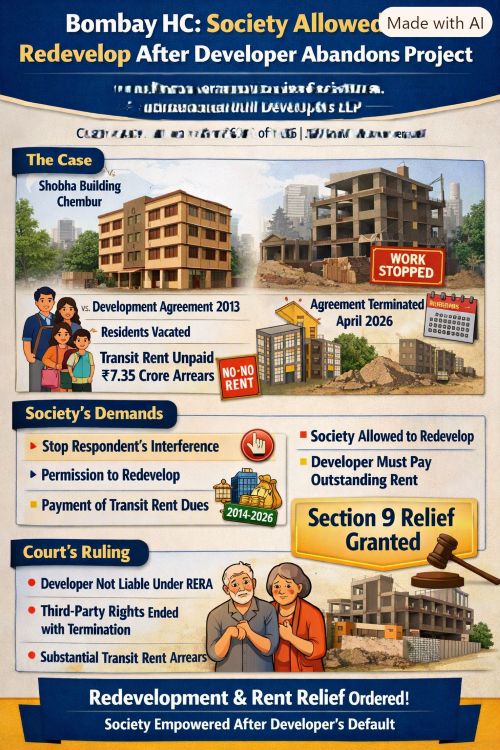
Bombay HC Allowed Society to Redevelop After Developer Default – Section 9 Interim Measures Granted
Judgment dated 16.10.2026 in Commercial Arbitration Petition (L) No.26942 of 2026 of Maruthi Cooperative Housing Society Limited Vs. Tridhaatu Maruthi Developers LLP and others
The petitioner has filed section 9 petition for interim measures of protection and restraining the respondents from redevelopment in the residential building “Shobha” constructed in 1976 and situated at Chembur. The Petitioner also seeks permission to undertake redevelopment of its property either by itself or through an appointment of a new developer. The Petitioner further seeks to restrain Respondent Nos. 1 and 2 from interfering with its redevelopment project.
The Petitioner also seeks payment of outstanding transit rent from June 2014 until the date of termination of the Development Agreement, i.e., 7th April 2026. The Petitioner also seeks other ancillary reliefs.
There was Development Agreement dated 10.7.2013 between the respondent no.1 appointed by the respondent no.2, and the petitioner society. All 22 members of the society had vacated the premises and handed over possession to the developer.
However, even after expiry of the stipulated period on 21.1.2018, the redevelopment was not completed. The developer stopped paying transit rent to the members.
As per an email dated 31st March 2026 sent by the Developer to the members of the Petitioner-Society, the aggregate contractors outstanding arrears towards transit rent payable to the members amounted to ₹ 7,35,07,670/- as of 7th April 2026, being the date of termination of the development agreement.
However, none of the provisions of RERA renders the owner of the freehold or leasehold interest in the land, who enters into a development agreement with a developer, liable for discharging the developer’s obligations under RERA merely because the developer subsequently enters into agreements for sale with third-party flat purchasers on the basis of such development agreement.
Considering the law laid down by this Court in the aforesaid judgments, this Court finds that there is no impediment to granting relief to the Petitioner under Section 9 of the Arbitration and Conciliation Act, 1996, notwithstanding the fact that the Project is registered under RERA and that third-party rights have been created by the Developer. The Developer has abandoned the Project, and the Society has terminated the Development Agreement. Consequently, the third-party rights created by the Developer cannot survive the termination of the Development Agreement.
- Substantial amounts are outstanding towards transit rent payable to the members of the Society. All the members are senior citizens, many of whom are super senior citizens, and are constrained to arrange alternative accommodation at their own expense and reside away from their original homes. The continued non-payment of transit rent has caused them considerable hardship.
- Further, the redevelopment of the property would require substantial funds, and the existing structure, which has been left abandoned by the Developer, would have to be demolished before fresh redevelopment can be undertaken. 54. This Court has consistently held that, in such circumstances, interim relief directing payment of transit rent can be granted. Appropriate directions permitting the Society to undertake redevelopment, together with all consequential reliefs, can also be granted in proceedings under Section 9 of the Arbitration and Conciliation Act, 1996.
- The Developer’s remedy, if any, would be to invoke arbitration against the Society in respect of its monetary claims, if otherwise maintainable in law. In the facts and circumstances of the present case, the Developer cannot insist upon preservation of the Development Agreement merely to retain its contractual rights, particularly when the Project has been abandoned and the transit rent payable to the members remains unpaid.
(i) Pending the arbitration proceedings and till making of the final award, there shall be interim measures in favour of the Petitioner and against the Respondent in terms of prayer clauses (a) to (p).