
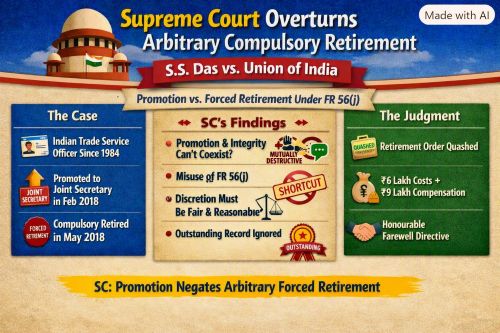
SC Landmark Judgment – Restores Justice, Integrity & Dignity of Govt Officer
Judgment dated 9.9.2026 of the Supreme Court in Civil Appeal No.3215 of 2026 S.S. Das Vs. Union of India
The appellant was appointed in the Indian Trade Service in 1984, promoted as Deputy Director General of Foreign Trade in 1994 and as Joint Director General in 2001.
By the order dated 10.5.2018, the appellant was retired compulsorily from the service without any fore-warning and without any complaint of worth.
Respondent-department was certainly entitled to review the services of the appellant, notwithstanding his promotion. But where the very same departmental machinery had, after consideration of his record, found him fit for a higher post of Joint Secretary, the subsequent conclusion that his continuance was no longer in public interest required more than a general invocation of the expression “questionable integrity”. The question, therefore, is not whether promotion offers carte blanche immunity against review of earlier service records, rather the question is whether the promotion, coupled with the subsequent record, constitutes relevant material which the reviewing authority has to meaningfully weigh. In our considered view, it does.
To repeat, the appellant was found fit for promotion by none other than the UPSC and granted promotion to the post of Joint Secretary barely two months prior to the order of retirement with the approval of the ACC. Such grant of promotion was an unequivocal recognition by the department concerned that the appellant’s service was not only highly satisfactory and meritorious but that he was an officer who should be entrusted higher responsibilities. Having promoted the appellant, barely a couple of months later, the superior officers in the department could not have branded him, so to say, ‘dead wood’ to justify weeding him out in purported public interest. The two actions are mutually destructive and cannot co-exist.
Law is well-settled that FR 56(j) can neither be invoked as a shortcut to avoid regular proceedings nor as a device to retire an officer either without material or to wreak vengeance or to satisfy vested interests. When ‘OUTSTANDING’ gradings are followed by a promotion, a subsequent subjective satisfaction that the service is not up to the required mark, without any intervening adverse material, could be declared ex facie arbitrary, perverse and a colourable exercise of power.
We need to remind the administrative officers that discretion is not a charter for arbitrariness. Discretion vests an officer empowered to decide fate of his subordinates with a choice between alternatives. When the statute, rule or regulation provides guidance for its exercise, the action must conform to it. When the statute, rule or regulation is silent, the power cannot be exercised whimsically or arbitrarily; it must be informed by reasonableness and fairness, as abuse or unfair use is never the legislative intent. It is, indeed, sad and unfortunate that these salient principles governing exercise of discretion were either not present to the mind of the officers concerned or, even if present, were consciously given a complete go-bye for extraneous considerations.
Also, we direct that the appellant shall be called back in office by the Director General of Foreign Trade for being bidden farewell with full honour and in like manner, which he would have received on the date of his superannuation but for the unceremonious premature severance of relationship. 69. The appeal, thus, stands allowed, with costs assessed at ₹ 6 (six) lakh to be paid by the respondent to the appellant. For the loss of reputation suffered by the appellant, we order the respondent to compensate him in a further sum of ₹ 9 (nine) lakh.