
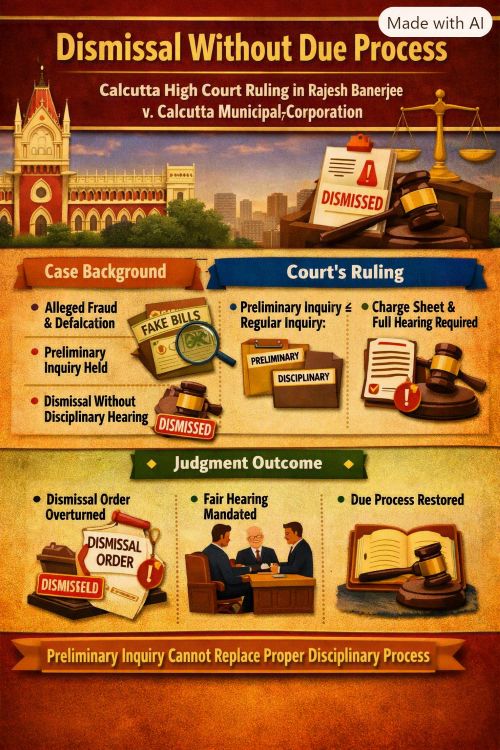
Preliminary Inquiry Cannot Substitute Disciplinary Inquiry for Dismissal Penalty
Judgment dated 28.8.2026 of the High Court of Calcutta (AS) in MAT No.666 of 2023 of Sri Rajesh Banerjee Vs. The Calcutta Municipal Corporation and others
In the preliminary inquiry, the appellant had given statement in respect of his involvement in the defalcation of money by raising fake bills. However, on the basis of said admission, the major penalty of dismissal was imposed without conducting disciplinary inquiry.
HELD that the preliminary enquiry was conducted upon the constitution of an Enquiry Committee on May 19, 2015. The same was a fact finding committee. The enquiry by the Committee did not partake the character of a regular enquiry as envisaged in a disciplinary proceeding, upon issuance of a charge sheet. The reason behind holding preliminary enquiries for commission of offences, was only to collect the facts, for formation of a, prima facie, opinion as to whether the delinquent employee had committed any misconduct. Such enquiries are conducted to ascertain whether the facts which may emerge during such enquiry were sufficient to proceed against the delinquent officer by holding a regular disciplinary proceeding. On the basis of the findings in a preliminary enquiry, no order of punishment cannot be imposed. A preliminary enquiry should not be confused with a regular enquiry, for the simple reason that a preliminary enquiry can also be held ex parte. Even if we hold that the appellant had confessed voluntarily, without any coercion (although, Mr. Sanyal contended otherwise), the preliminary enquiry in this case, cannot be held to be a regular enquiry and as such, using the report of the Enquiry Committee as concrete proof of guilt and issuance of the order of dismissal without giving the appellant an opportunity to rebut the same by leading evidence, is violative of the principles of natural justice. The findings in the preliminary enquiry report are only, prima facie, evidence. At best, the enquiry report and the admission of guilt by way of the confessional statement, could be used as evidence against the appellant, but the appellant should have been 13 granted an opportunity to rebut the same upon issuance of a charge sheet, clearly spelling out the charges against him, so that, he knew what were the allegations he was required to meet and also got a chance to explain the circumstances under which the confessional statement was issued. Even if we hold that investigation by the Vigilance Commission as per the Vigilance Rules are not mandatory, we do not find any answer as to why the Corporation did not deem it fit to refer the matter to its own Vigilance Department when defalcation of public money was involved. Secondly, the Enquiry Committee being a fact finding committee was required to forward its report containing the facts which came to light during such enquiry, but it could not have recommended that the most stringent punishment should be imposed upon the appellant, without following the due process of law.