
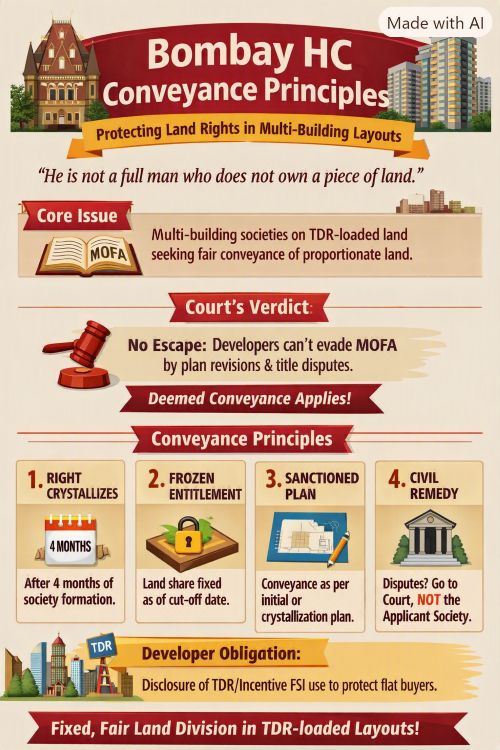
Conveyance – From Plinth to Proportionate Fair Land Division for Multiple Buildings
Judgment dated 16.9.2026 of the High Court of Bombay in Writ Petition No.1128 of 2026 of Satellite Garden I Cooperative Housing Society Ltd Vs. State of Maharashtra through Ministry of Housing and others with connected writ petitions.
Prologue “ He is not a full man who does not own a piece of land. The above ancient proverb underscores the importance of ownership of land and applies befittingly to the situation of denial of title in the land to the home buyers in multi-storey buildings.
The land admeasuring 55,696.70 sq.m. located at A.K. Vaidya Marg, Goregaon (E), Mumbai- 400063 was owned by Kadam family. Development rights in respect of the larger land admeasuring 55,696.7 sq.m. were granted by the landowners in favour of BPM Industries, now named as Satellite Developers Ltd. (developer) in the year 1995-96. An exemption under the provisions of Urban Land (Ceiling and Regulation) Act, 1976 (ULC Act) was obtained and the land was apparently subdivided into Sub-Plot Nos. A, B, C, and D.
Three housing societies have filed writ petitions challenging different orders of the competent authority in respect of conveyance.
The issue that is taken up for consideration in the present Petitions is about conveyance of land to the organisations of flat purchasers, whose buildings are situated in a layout development. When more than one building is constructed in a layout land and FSI and BUA sanctioned in respect of the entire layout land is distributed for construction of various buildings in the layout, division of the layout land for conveyance purposes many times becomes a contentious issue. This is particularly when the buildings are constructed by utilisation of BUAs under different schemes/potentials, such as (i) buildings constructed with base/inherent FSI, (ii) buildings constructed with use of full/partial TDR, (iii) buildings constructed with base FSI, but flowing through different FSI regimes (iv) buildings constructed under incentive schemes such as cluster development, slum schemes, IT Parks etc. In such a situation, it becomes difficult to have an apple-to-apple comparison for the purpose of proportionate distribution of land in the layout to be conveyed to organisations of flat purchasers formed by different buildings.
in respect of the 4 buildings already constructed and 1 building yet to be constructed in the layout development of Sub-Plot A, conveyance has been granted in respect of 3 buildings by the Competent Authority, a Suit for conveyance of one building is pending and the 5th building is yet to be constructed. Though Competent Authority has granted conveyance to the 3 buildings, it has not applied uniform yardstick for deciding entitlements of even those 3 buildings in respect of the land in the layout.
The issue for consideration is whether the Competent Authority can be prevented from exercising jurisdiction under Section 11 of the MOFA merely because the developer has committed the mischief and group of getting the plans revised during currency of the layout development? Can the argument of creation of title dispute relating to proportionate land division be permitted to be raised for the purpose of defeating the jurisdiction of the Competent Authority under Section 11 of the MOFA? The answer, to my mind, appears to be in the negative. After all, MOFA and particularly the 2008 amendment introducing the concept of deemed conveyance is aimed at preventing the mischief by the developers.
Thus, under the GR dated 22 June 2018, in a layout development involving multiple buildings, the land can be conveyed proportionate to the BUA utilized for construction of each building. However, the GR also provides that where TDR is used for construction of buildings, only plinth and appurtenant areas can be conveyed. This part of the GR is already interpreted by this Court in Neelkanth Mansion (supra) in which it is held that in every case where TDR is used, it is not necessary to give a go-by to the principle of proportionate land division.
RINCIPLES FOR CONVEYANCE OF LAND IN LAYOUT DEVELOPMENTS
223) From the above discussion, following principles emerge:
(a) The right to secure conveyance of the land and the building inures in favour of the organisation of flat purchasers upon expiry of the period prescribed in Section 11 of the MOFA read with Rule 9 of MOF Rules. (b) Consequently, in a layout development, the proportionate land which was meant to be conveyed in favour of an organisation of flat purchasers, as on the date of expiry of period of four months from its formation, stands crystallised and frozen and shall not get reduced merely on account of subsequent revision of the plans. (c) The conveyance or deemed conveyance of land in a layout development by undertaking the exercise of land division and group proportionate to BUA used in construction of each building shall be on the basis of either the first sanctioned plan or the plan sanctioned as on the date when freezing/crystallisation occurs i.e. when the period specified under Rule 9 of the MOF Rules expires. (d) The above principle shall however be subject to an exception where the flat purchasers of earlier buildings/their societies have given a written consent for modification/revision of the plan, in which case, the exercise of proportionate land division can be undertaken by taking into consideration the plan, which has such consent. (e) The Competent Authority accordingly needs to convey the proportionate land to the societies in a layout by taking into consideration the sanctioned plan, which existed at the time when the time prescribed under Rule 9 of the MOF Rules had expired from the date of formation of organisation of flat purchasers or the plan which has the written consent as discussed above, whichever is later. (f) If the developer or any other organisation of flat purchasers in the layout are aggrieved by land division as discussed above and are able to demonstrate land entitlement to the contrary, they need to file a suit questioning the land conveyed by the Competent Authority. A society seeking conveyance of land by application of principle of freezing/crystallisation need not be driven to Civil Court for seeking conveyance of the proportionate land. (g) Developers and promoters shall give adequate notice to the flat purchasers about construction of the building by use of incentive FSI / TDR having and the potential risk of securing lesser land as compared to BUA used in construction of their building(s)
Frozen Rights of Societies in Fluid Layouts of Multiple Buildings and emed Conveyance
Bombay HC Landmark Judgment on Fair Land Division under MOFA from Plinth to Proportion