
SC Restores Finding of Gender Bias in Denial of Employment & Grants Compensation
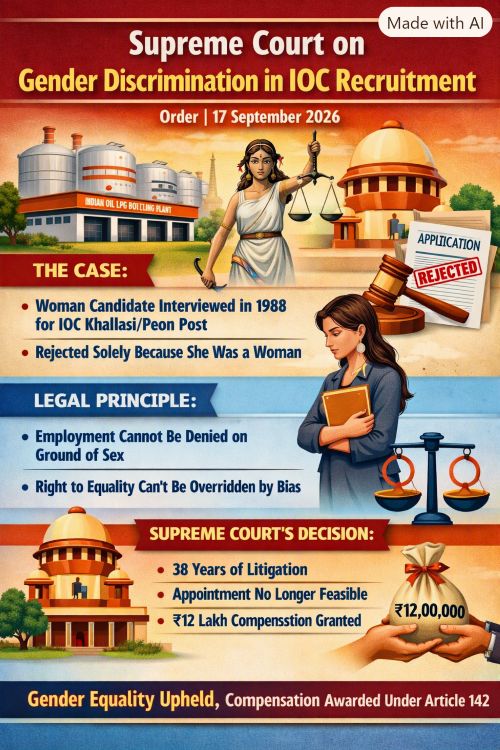
SC Reaffirmed that employment cannot be denied on the ground of sex.
SC invoked its inherent powers to award monetary compensation to a woman candidate for proven gender discrimination in recruitment of Indian Oil Corporation since appointment is not longer feasible after decades of litigation.
Decades of Litigation & Proven Gender Discrimination in Recruitment of Indian Oil Corporation – SC exercises inherent powers for monetary compensation.
Order dated 17.9.2026 of the Supreme Courtin SLP (Civil) No.19874 of 2026 of Sumitra Vs. Indian Oil Corporation Ltd & Others
Recruitment of Casual Khallasi / Peon for LPG Bottling Plant of IOC.
The appellant was amongst 49 persons who wer recommended for the said post. She was interviewed but was not given appointment on the ground that she is woman. IOC stated that the appellant fulfilled the eligibility except the fact that she is a lady.
The issue is whether the appellant, having been treated as eligible, called for interview and subjected to the same recruitment processes as like other candidates, could thereafter be excluded from consideration merely because she was a lady?
The fact that the appellant did not acquire a vested right to appointment, does not mean that the recruitment process was beyond pale of judicial scrutiny. An authority conducting recruitment is required or expected to act in accordance with law even at the stage of selection. The absence of an indefeasible right to appointment cannot be treated as license to discriminate between eligible candidates on the ground of sex.
The appellant was interviewed in 1988, she never entered into the service of the Corporation. The proposed engagement on daily wages in the casual appointment, was not against sanctioned post. Nearly 38 years have lapsed since the recruitment process had commenced. The appellant is now stated to be about 63 years of age which is beyond the age of superannuation, as stated by the corporation. In these circumstances, the direction for appointment by restoring the decree of the trial court, would not be feasible, nor it would constitute an appropriate forum for service relief. 9. The court must, however, ensure that the passage of time or delay, which was not attributable to any acts of the appellant, by itself could be a ground to deny the relief after having effectively defended her right for the years and clearly established by both, oral and documentary evidence, that her exclusion from the recruitment process was unlawful. Thus, the relief must consequently be moulded to meet the ends of justice. In the peculiar facts and circumstances of the case, the compensation in leiu of appointment, would constitute appropriate relief.
The finding of the trial court that the appellant was excluded from the recruitment process on the ground that she was a woman, is required to be restored and accordingly to that extent it is restored. However, having regard to the passage of time, the nature of original engagement, the fact that the appellant never entered service and her present age, no direction for appointment or absorption can now be issued. In exercise of the constitutional power vested under Article 142 of the Constitution of India, we mould the relief in the peculiar facts of the present case by directing the Respondent Nos. 1 and 2 to pay the appellant a sum of Rs.12,00,000/- (Rupees Twelve Lakhs), as compensation in lieu of appointment.