
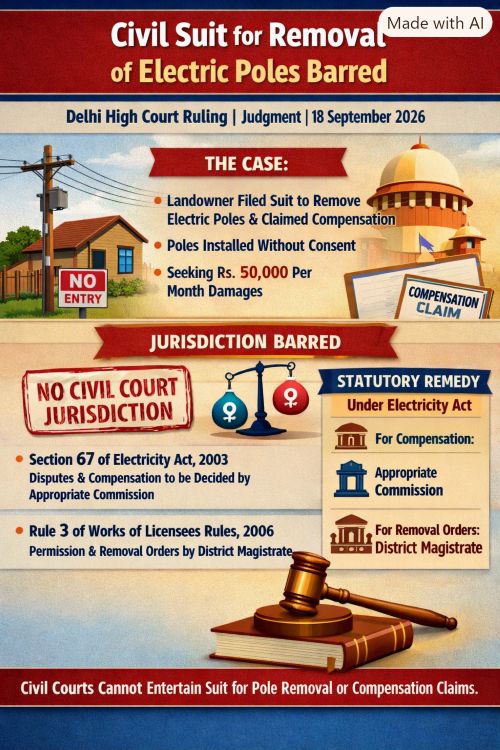
Delhi HC – Civil Suit for Removal of Electric Poles & Compensation Not Maintainable
Judgment dated 18.9.2026 of the High Court of Delhi in RS 115/2026
Civil Suit for removal Electric Poles & Compensation – Barred under Section 67 of the Electricity Act 2003 and rule 3 of the Works of Licensees rules, 2006.
The plaintiff filed the suit for permanent & mandatory injunction and recovery of damages of Rs.50,000 per month, in respect of illegal installation of electric poles in his property without his prior permission or consent or No objection.
“ Section 67 – 3. A licencee shall in exercise of any of the powers conferred by or under this Section and the rules made there under, cause as little damage, detriment and in convenience as may be, and shall make full compensation for any damages, detriment or inconvenience caused by him or by anyone employed by him.” 4. where any difference or dispute including amount of compensation under sub Section 3 arises under this section, the matter shall be determined by the Appropriate Commission.” 46. Rule 3 of The Works of Licensees Rules, 2006 reads as under: “A licencee may-(a) carry out works, lay down or place any electric supply line or other works in, through, or against, any building, or on, over or under any land whereon, where-over or where-under any electric supply RSA 115/2026 Page 14 of 19 line or work has not already been lawfully laid down or placed by such licencee, with the prior consent of the owner or occupier of any building or land. Provided that in case where the owner or occupier of the building or land raises objections in respect of works to be carried out under this rule, the licencee shall obtain permission in writing from the District Magistrate or the Commissioner of Police or any other officer authorized by the State Government in this behalf for carrying out the works. Provided further that if at any time, the owner or occupier of any building or land on which any works have been carried out or any support of an overhead line, stay or strums has been fixed shows sufficient cause, the District Magistrate or the commissioner of Police or the officer authorized may by order in writing direct for any such works, support, stay or strut to be removed or altered.” 47. In view of this rule, it is evident that if the Licencee erects any Poles,etc. for providing the Electricity on the land owned by third party, it shall obtain prior consent of the owner or occupier of any building or land. In case any objection is taken by the owner, as in the present case, the licencee was mandated to obtain permission in writing from the District Magistrate or the Commissioner of Police or any other officer so authorized by the State. As had been rightly noted, no permission was ever sought from the owner or the competent Authority.
It is evident that the Civil Court has no jurisdiction to entertain the Suit to grant compensation for unauthorized erection of poles and laying of electricity wires. The learned Civil Judge has rightly held that the jurisdiction of the Civil Court is expressly barred under Section 67 Electricity Act and Rule 3 of the Works of Licenses Act, 2006 and, therefore, no relief could be granted to the Plaintiff and the relief has been rightly denied.
A landowner objecting to erection of electric poles on private property must approach the District Magistrate (for removal/alteration) and the Appropriate Commission (for compensation). A Civil Court cannot entertain a suit for such reliefs because the Electricity Act, 2003 provides a complete and exclusive statutory remedy