
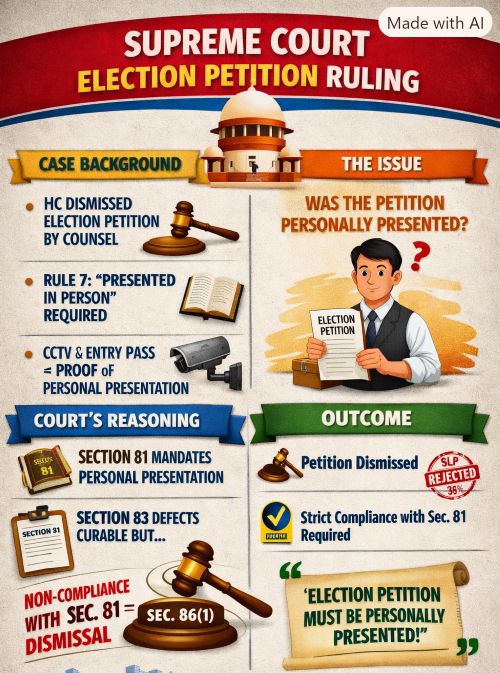
Supreme Court – RP Act Election Petition Must Be Personally Presented
Judgment dated of the Supreme Court in SPL (Civil) No.30538 of 2026 of V. Pon. Paneerselvam Vs. S. Regupathy and others
The question arising in the present petition is whether presentation of an election petition by the petitioner in person is a mandatory requirement under Section 81 of the Representation of the People Act, 19511, and whether non-compliance with such a requirement, if any, renders the election petition liable to dismissal at the threshold under Section 86(1) of the RP Act.
The grouse of the petitioner arises from the impugned judgment and order dated 22.07.2026 in ELP No.36/2026, whereby the High Court dismissed the petitioner’s election petition as not maintainable, predicating on the ground that the election petition had been presented by the petitioner’s counsel. The High Court referred to Rule 7 of the Madras High Court Election Petitions Rules, 1967, which mandated that every election petition shall be presented by the petitioner in person before the II Assistant Registrar, Original Side, High Court or, in his absence, before such officer of the Court as the Registrar of the High Court may direct.
The present controversy needs to be examined in the light of Sections 81 and 86 of the RP Act, which respectively deal with the presentation of an election petition and the consequence of non-compliance with the statutory requirements.
Reverting to factual sphere of the case, the petitioner asserts that he personally presented the Election Petition before the Registry on 16.06.2026. However, this assertion is not supported by any contemporaneous record evidencing the act of presentation itself. The CISF entry pass relied upon by him establishes his entry into the premises of the High Court on 16.06.2026; it does not establish anything remotely suggesting that he personally presented the petition. Significantly, the receipt evidencing the security deposit under Section 117 of the RP Act was issued in the name of the petitioner’s counsel. As regards the CCTV footage, the petitioner asserts that it captured the presentation and his personal verification, the footage itself, can at the highest, establish the petitioner’s presence in the premises and nothing else.
he decision, in fact, draws a clear distinction between the requirements of Section 81 and those of Section 83. While considering the consequence of non-compliance with Section 83(1), this Court held that such defect could not entail dismissal under Section 86(1), since Section 83 is not one of the provisions specified in Section 86(1). The Court, however, expressly affirmed that an election petition which does not comply with the requirements of Section 81 is liable to dismissal in limine under Section 86(1).