
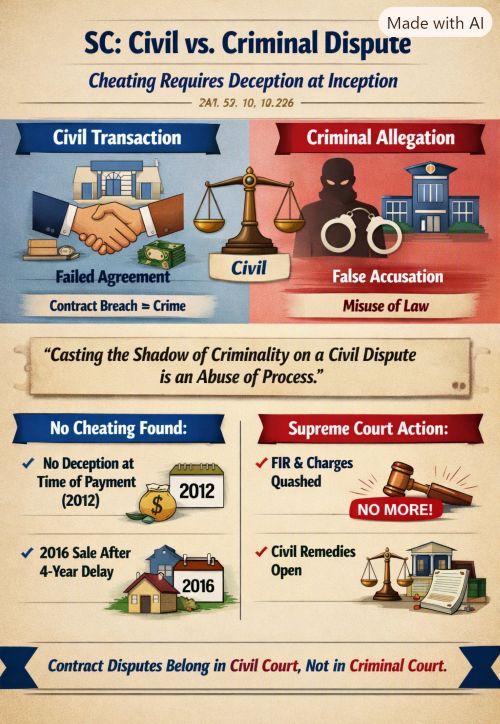
SC – Civil Dispute Cannot Be Criminalise
5.10.2026 Judgment of the Supreme Court in SLP (Criminal) No.12638 of 2022 of Sudha Rakesh Vs. The State of Karnataka and another
The tendency of litigants to colourize civil disputes into criminal offences is an open secret in the present times. The courts have tried to put their foot down to prevent the litigants from obliterating the fine distinction between the two. We have done so to prevent the abuse of criminal process. The instant case presents a similar opportunity
The landowners entered into an agreement for sale dated 05.10.2012 purporting to sell the subject land in favour of the petitioner herein. They also executed a General Power of Attorney (“GPA”) dated 05.10.2012 in favour of the petitioner. Thereafter, the landowners, acting through their GPA holder/petitioner, entered into another agreement dated 19.11.2012 with respondent no. 2 and one Kalpana Sure (“prospective buyers”) for sale of the subject land.
As per this agreement, the prospective buyers were required to pay the balance sale consideration and come forward for execution of sale deed within 7 months from the date of agreement. They never turned up. The petitioner and landowners waited even beyond the period of 7 months and till the expiry of the limitation period for seeking specific performance. The prospective buyers took no action whatsoever and eventually, the petitioner and landowners sold the subject land by executing a sale deed dated 11.02.2016 in favour of one Gaffar Baig (“ultimate buyer”).
immediately thereafter, the prospective buyers instituted a civil suit for specific performance of the agreement for sale executed on 19.11.2012. Subsequently, they also lodged a criminal complaint on 13.05.2016, which was registered as FIR No. 121/2016 under Sections 420, 423, 120-B read with Section 34 of Indian Penal Code, 1860 (“IPC”). The petitioner was named as an accused in the said FIR along with the landowners. After the filing of final report, the Magistrate took cognizance of the offences on 28.09.2017.
Notably, the offence of cheating requires a deceptive act which leads to inducement for delivery of property/money. Even on bare perusal of the allegations, it becomes clear that the property (that is the amount transferred by respondent no. 2 at the time of agreement for sale dated 19.11.2012) was not transferred on the basis of any deception. At that time, the property could have legitimately been transferred in favour of respondent no. 2 and there was no deception. The subsequent sale took place in 2016, almost 4 years after the alleged delivery of money by respondent no. 2. Thus, the foundational ingredient of cheating is missing. Section 423 IPC is also mis-invoked in the FIR. It requires a false statement as to consideration in an instrument of transfer. There is no such false statement in the agreement dated 19.11.2012 or in the sale deed. Even if there is any false averment in the sale deed, it ought to have created a right in favour of the ultimate buyer Mr. Gaffar Baig and not respondent no. 2 herein. It is a classic case of casting the shadow of criminality on a pure civil dispute.