Cashless Facility Denial and Repeated Documents Demand – Illegal
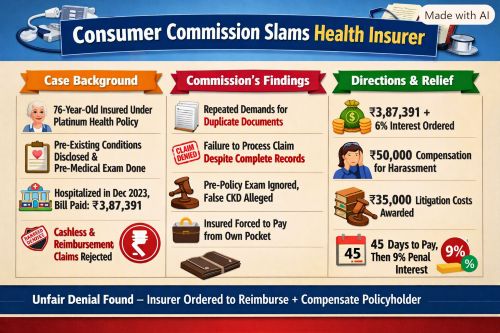
The complainant had taken health insurance policies under Platinum variant and while obtaining both the policies, she had duly disclosed her existing medical conditions. According to the complainant, the pre-existing medical conditions were disclosed in the policy documents. Moreover, the insurer conducted medical examination of the complainant before issuance of the policy. The said medical examination report did not disclose any pre-existing disease relating to heart or kidneys.
On 22.12.2023, the complainant consulted her family doctor through telecommunication and was advised on 23.12.2023 to consult another doctor for iron therapy. On the same day, she was admitted to the Emergency Department of Max Hospital. During the initial emergency assessment, the Emergency Resident Doctor inadvertently recorded CKD (Chronic Kidney Disease) in the medical record. The complainant asserts that the said entry was erroneous and was subsequently corrected by an addendum dated 30.12.2023, during the very same hospital admission. During the said hospitalisation, a cashless claim request bearing ID 793111 was submitted to the Opposite Party.
The complainant had submitted the additional information through service provider / TPA to the Insurer in response to its email dated 26.12.2023.
On 27.12.2023, the Opposite Party again sought additional information, including a treating doctor’s certificate mentioning the duration and etiology of the ailment and treatment records, including past treatment records relating to heart disease. The complainant, by email dated 29.12.2023, furnished the additional information.
However, the cashless claim was not approved by the Opposite Party, the reason communicated being insufficiency/non-submission of the requisite documents. The complainant has alleged that the refusal of cashless authorisation was unjustified and amounted to deficiency in service. She submits that she was a senior citizen and was undergoing hospitalisation and treatment and that, because cashless authorisation was not granted, she was compelled to arrange funds herself. The complainant was discharged from the hospital on 30.12.2023. The total hospital bill, according to the complainant, amounted to ₹3,87,391/-, which she paid herself.
Then the complainant submitted the claim of reimbursement. However, after lot of correspondence, the said claim for reimbursement was also rejected.
The complainant has further pleaded that, being a senior citizen and aged about 76 years, she has suffered additional hardship and apprehension regarding her future insurance coverage. The complainant has prayed for reimbursement of ₹3,87,391/-, being the hospital expenses incurred by her, along with appropriate interest, compensation for mental agony and harassment and litigation expenses of ₹1,00,000/-. The complainant has also referred to the provisions relating to product liability under the Consumer Protection Act, 2019 and has alleged that the conduct of the Opposite Party amounts to deficiency in service and unfair trade practice and has caused financial, physical and mental harm to her.
The central controversy relates to the manner in which the Opposite Party dealt with the claim, particularly its repeated demands for additional medical documentation and its ultimate rejection of the claim on the ground of non-submission of documents. The documentary record reveals a prolonged series of communications between the complainant and the Opposite Party. The correspondence demonstrates that the Opposite Party repeatedly sought medical records and clarifications from the complainant.
- Thus, the Commission is confronted with a situation where the medical record itself contained an explanation of the apparent discrepancy, a contemporaneous correction by way of an addendum, and a further clarification from the treating doctor. In these circumstances, the requirement of repeatedly obtaining substantially the same clarification, particularly when the Emergency Doctor had already corrected the record during the same admission, cannot be regarded as a reasonable basis for keeping the claim indefinitely pending. 11. The Opposite Party was required to assess the claim on the basis of the material available to it and to take a reasoned decision in accordance with the terms of the policy. An insurer is undoubtedly entitled to seek reasonable and relevant documents for verification of a claim. However, such right cannot be exercised in a manner whereby the insured is repeatedly called upon to furnish documents which have already been supplied or documents which, in the circumstances, are not reasonably capable of being obtained.
In Civil Appeal No.8386/2015 Manmohan Nanda Vs. United India Assurance Co. Ltd. & Anr, the Hon’ble Supreme Court has also recognised, in the context of health insurance, that where the insurer undertakes medical assessment before issuing a policy and thereafter issues the policy, the insurer must assess the medical risk on the basis of the medical information available to it; it cannot subsequently rely upon an alleged pre-existing medical condition in circumstances inconsistent with its own pre-policy assessment.
The very purpose of availing health insurance with a cashless facility is to enable the insured, subject to the terms of the policy and admissibility of the claim, to obtain hospital treatment without having to arrange the entire hospital expenditure immediately from personal resources.
The complainant was required to undergo prolonged correspondence with the Opposite Party and repeatedly furnish documents and clarifications in respect of her medical claim. Despite the documents and medical clarification being placed before the Opposite Party, her claim was ultimately rejected. The complainant was consequently required to bear medical expenditure of ₹3,87,391/- from her own resources despite having taken health insurance coverage and having paid the stipulated premiums. The complainant has also pleaded that she is a senior citizen aged about 76 years.
Judgment dated 24.9.2026 of the District Consumer Disputes Redressal Commission VIII (Central) in Consumer Complaint No.DC/77/CC/429/2024 of the complainant against Niva Bupa Health Insurance and Max Super Speciality Hospital.