
2026LatestLegalSupreme Court

Supreme Court – RP Act Election Petition Must Be Personally Presented

Judgment dated of the Supreme Court in SPL (Civil) No.30538 of 2026 of V. Pon. Paneerselvam  Vs.  S. Regupathy and others

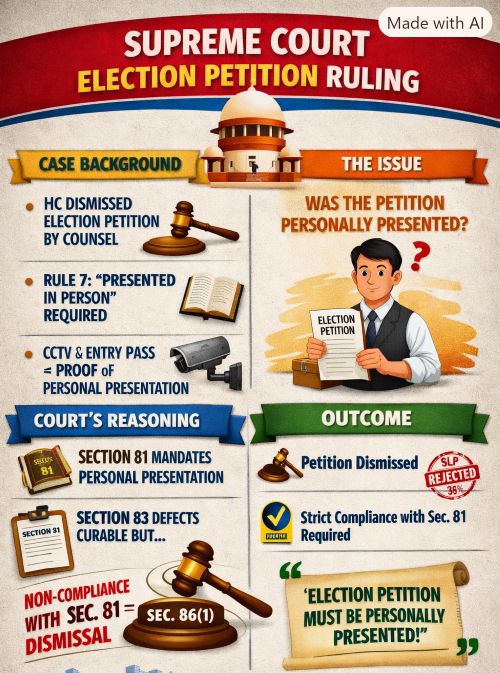
The question arising in the present petition is whether presentation of an election petition by the petitioner in person is a mandatory requirement under Section 81 of the Representation of the People Act, 19511, and whether non-compliance with such a requirement, if any, renders the election petition liable to dismissal at the threshold under Section 86(1) of the RP Act.

The grouse of the petitioner arises from the impugned judgment and order dated 22.07.2026 in ELP No.36/2026, whereby the High Court dismissed the petitioner’s election petition as not maintainable, predicating on the ground that the election petition had been presented by the petitioner’s counsel. The High Court referred to Rule 7 of the Madras High Court Election Petitions Rules, 1967, which mandated that every election petition shall be presented by the petitioner in person before the II Assistant Registrar, Original Side, High Court or, in his absence, before such officer of the Court as the Registrar of the High Court may direct.

The present controversy needs to be examined in the light of Sections 81 and 86 of the RP Act, which respectively deal with the presentation of an election petition and the consequence of non-compliance with the statutory requirements.

Reverting to factual sphere of the case, the petitioner asserts that he personally presented the Election Petition before the Registry on 16.06.2026. However, this assertion is not supported by any contemporaneous record evidencing the act of presentation itself. The CISF entry pass relied upon by him establishes his entry into the premises of the High Court on 16.06.2026; it does not establish anything remotely suggesting that he personally presented the petition. Significantly, the receipt evidencing the security deposit under Section 117 of the RP Act was issued in the name of the petitioner’s counsel. As regards the CCTV footage, the petitioner asserts that it captured the presentation and his personal verification, the footage itself, can at the highest, establish the petitioner’s presence in the premises and nothing else.

he decision, in fact, draws a clear distinction between the requirements of Section 81 and those of Section 83. While considering the consequence of non-compliance with Section 83(1), this Court held that such defect could not entail dismissal under Section 86(1), since Section 83 is not one of the provisions specified in Section 86(1). The Court, however, expressly affirmed that an election petition which does not comply with the requirements of Section 81 is liable to dismissal in limine under Section 86(1).


Leave a Reply

Your email address will not be published. Required fields are marked *

I HAVE READ THE DISCLAIMER AND AGREE TO IT.

User Acknowledgement

By proceeding further and clicking on the "AGREE" button herein below, I acknowledge that I of my own accord wish to know more about LegalDeli for my own information and use. I further acknowledge that there has been no solicitation, invitation or inducement of any sort whatsoever from LegalDeli or any of its members to create an Attorney-Client relationship through this knowledge site. I further acknowledge having read and understood the Disclaimer below.

Disclaimer
About: This knowledge-site (www.LegalDeli.in) is owned and operated by LegalDeli (“LD”), and is a resource for your informational and educational purposes only.

No Warranty: LD does not warrant that any content or information contained on this knowledge-site is accurate, correct, complete or up-to-date, and hereby disclaims any and all liability to any person for any actual or threatened loss or damage caused by errors or omissions, whether such errors or omissions result from negligence, accident or otherwise. LD assumes no liability for the interpretation and/or use of the content and/or information contained on this knowledge-site, nor does it offer any warranty of any kind, either expressed or implied in relation to such content or information.

Third-Party Links: LD does not intend that links / URLs contained on this knowledge-site re-directing users to third party websites be considered as referrals to, endorsements of, or affiliations with any such third party website operators. LD is not responsible for, and makes no representations or warranties, express or implied, about the content or information contained on such third party websites to which links may be provided on this knowledge-site.

No Legal Advice: By clicking ‘I agree’ and proceeding further, you acknowledge, represent and undertake that you on your own accord wish to know more about LD, its capabilities and research content and information contained on the knowledge-site, for your own knowledge and personal use. The content and information contained on this knowledge-site should not be construed as nor relied upon as legal advice. You as a reader or recipient of content or information contained in this knowledge-site should not act, nor refrain from acting, based upon any or all of such content or information, but should always seek the advice of competent legal counsel licensed to practice the relevant law in the appropriate jurisdiction.

No Attorney-Client Relationship: This knowledge-site is not intended to be and you should not consider the content or information contained therein to be an advertisement, solicitation, inducement or invitation for an Attorney-Client relationship. Transmission, receipt or use of this knowledge-site, including content and information contained therein, does not constitute nor create an Attorney-Client relationship between LD and you.