
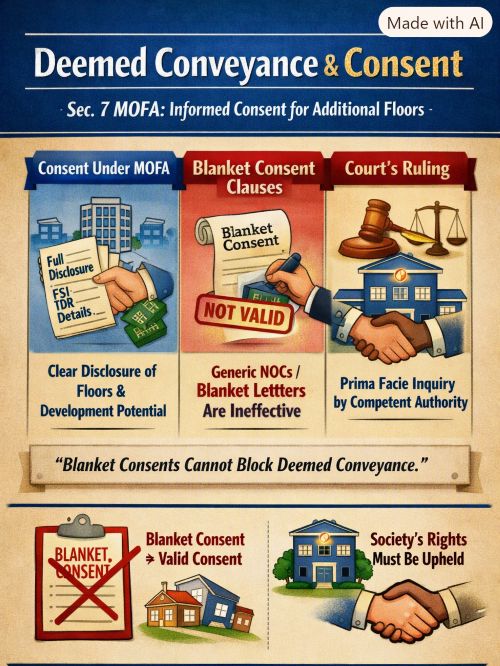
Developers Cannot Stall Conveyance Using Blanket Consent for Additional Floors
Deemed Conveyance & Additional Construction of Floors – NOC of Flat Purchasers – Section 7 MOFA
By the order dated 29 July 2024 passed by the District Deputy Registrar, Co-operative Societies, Mumbai City (3) and Competent Authority (Competent Authority) rejecting Application No.8 of 2024 filed seeking certificate of unilateral deemed conveyance in respect of the land and the building. Deemed Conveyance is denied to the Petitioner-society inter alia on the grounds that Respondent No.2-developer is undergoing Corporate Insolvency Resolution Process (CIRP) and that Respondent No.2 is katkam Uploaded on – 06/10/2026 Page No. 1 of 45 Downloaded on – 07/10/2026 14:12:36 k 2/45 WP 17527 of 2024 entitled to carry out additional construction of 7th and 8th floors on the building.
Respondent No.2 accordingly relies on contractual covenants as well as specific NOCs / consent letters executed by individual flat purchasers in support of his contention that there is a consent given by the flat purchasers within the meaning of Section 7 of MOFA for construction of additional floors/flats in the building. Under Section 7 of the MOFA, there is an embargo on the promoter from making any alteration in the structure of the flat or in making alterations or additions in the structure of the building without the previous consent of purchasers who have agreed to take flats in such building.
There is fine distinction between ‘existence of consent’ and ‘validity of consent’. While the Competent Authority can record a finding about ‘existence’ of consent, it cannot determine the issue of ‘valid’ consent, which inquiry would fall squarely into the realm of a Civil Court. However, whether mere production of a consent letter would ouster jurisdiction of the Competent Authority is the issue for consideration. 38. Promoters and developers do incorporate wide and blanket clauses in the Agreements for Sale for recognising their entitlement to milk future development potential in the land and the building. These are popularly known as ‘blanket consent’ clauses. By now, the law is well settled that such blanket consent clauses are ineffective/unenforceable and do not entitle a developer to carry out additional construction in the building or in the layout. While seeking consent of flat purchasers for putting up additional construction in the building or in the layout, it is mandatory that a full disclosure is made to the flat purchasers about the nature of additional construction. This would include disclosure of the existing development potential, the additional development potential made available, number of additional floors and additional flats to be constructed etc. A developer cannot simply secure consent to put up additional construction without making disclosure of the necessary details. By now, the law is well settled in this regard by judgments of this Court in Dosti Corporation, Eternia CHSL and Ors. Vs Lakeview Developers and Ors.11 and Rajkumar Gulati and Ors. Versus. S.D. Corporation Pvt. Ltd. and Ors12. 39. Over the period of time, the promoters have exhibited a tendency to circumvent the statutory provisions under MOFA about embargo on additional construction contrary to disclosures. Obtaining blanket consents from flat purchasers was one of the modus operandi, which Courts were required to hold as unenforceable. After the blanket consent clauses are held to be unenforceable, the developers have in some cases started segregating the blanket consent clause from the Agreements and printed the same in the form of a separate letter. The clause is virtually the same empowering additional construction without adequate disclosure. However, the same is in the form of a separate letter. The issue for consideration is if such kind of consent letters are produced, whether the Competent Authority would immediately lose jurisdiction to decide the application of deemed conveyance on the ground that the full construction as per the consent letter is yet to be completed? Again, the answer to my mind appears to be in the negative. Some prima facie inquiry by the Competent Authority into ‘existence’ of consent would be necessary and production of such letters would not mean that existence of consent is proved. It can record a finding that the consent letters do not conform to the requirement of Section 7 of MOFA. Such finding would be rebuttable and can be questioned by the aggrieved developer before the Civil Court. If it is held that the competent authority must reject the application for deemed conveyance upon production of such letters containing blanket consent clauses, the developers would take disadvantage of such situation and would thereby delay conveyance of land by securing such letters from flat purchasers while selling the flats.