
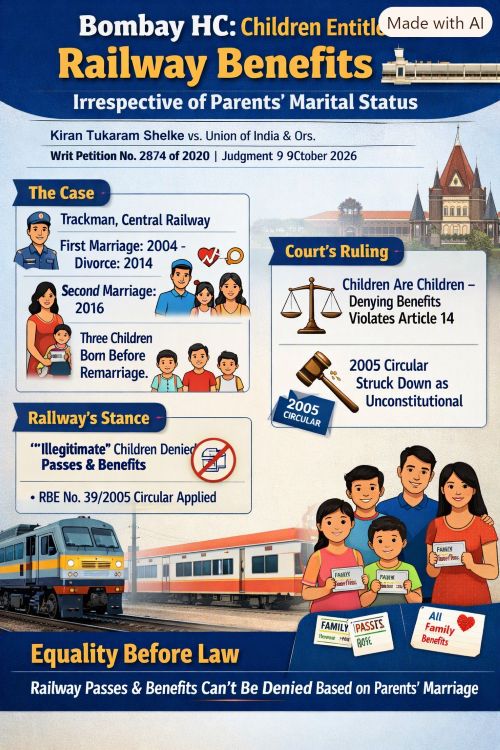
Children are Children – Denial of Benefits for Illegitimate Marriage of Railway Employee
The Petitioner was working as Trackman in Engineering Department under Sr. Section Engineer (Maint.), Wadi Bunder, Mumbai Division of Central Railway. Initially, Petitioner was appointed in the year 2010 as Gangman and later on re-designated as Trackman. He married with one Ms. Shobha on 12th May 2004 as per the Hindu rites and rituals. However, due to some differences, they started living separately and later on, obtained divorce by mutual consent through a decree of the Family Court No.7, Mumbai, on 24th September 2014. Subsequently, he got married with one Ms. Jyoti Valiba Avhad on 13th June 2016, which was registered under the Hindu Marriage Act, 1955 (for short, “Hindu Marriage Act”) on 27th June 2016. 3.2. It appears that during the subsistence of his previous marriage, Petitioner had developed relation with Ms. Jyoti (now wife) who gave birth to three children prior to their marriage. One daughter was born on 24th October 2009 and two sons were born on 21st April 2012 and 10th February 2016 respectively. Petitioner also claimed that he is acting as guardian of his children since their birth and accordingly, his name is also mentioned as father in the birth certificates issued in their favour by the Local Bodies. 3.3 On 18th July 2016, the Petitioner moved an Application to Assistant Divisional Engineer (M), Mankhurd through Sr. Section Engineer (P.Way), Wadi Bunder to inform about his divorce and to include the name of his second wife and three children for Railway Record (Service Register) for availing Family Pass/PTOs, Family Medical Facility, Nominations for different dues after his sad demise, etc. Consequently, the office of ADEN (M) MKRD vide its letter dated 26th July 2016 forwarded the case of the Petitioner to DRM(P) CSTM for opinion of the Law Officer at Headquater’s office, CSMT, Mumbai. 3.4 The Headquarter’s Office, Personnel Branch, CSMT, Mumbai vide letter dated 2nd May 2017 (for short “Impugned Letter”) had advised that Smt. Jyoti, being the legally wedded wife, she is eligible for entry of her name in the Service Register of the Petitioner and for other benefits. However, the children who are born prior to their marriage and in view of Section 16 of the Hindu Marriage Act, they are illegitimate and entitled only for limited purpose of sharing property of their parents. It had also been clarified that the children will be eligible for family pension in their turn subject to fulfillment of conditions prescribed for the drawl of such pension from time to time. A reference was also made to Railway Board’s letter dated 14th February, 1997 and it was stated that the children will be not eligible for any kind of Railway Passes as clarified by the Railway Board vide RBE No.39/2005 dated 10th March 2025. (for short “Impugned Circular”)
The gravamen in this proceedings relates as to whether the children born to a railway servant can be denied privilege passes, medical facilities etc. by railway administration on the ground that the children are born to second wife during the subsistence of previous marriage in light of the Impugned Circular issued by the Railway Board and also whether the Impugned Judgment and Order passed by the Tribunal is sustainable in the eyes of law.
the Ministry of Personnel Public Grievances and Pensions, Department of Pension & Pensioners’ Welfare by O.M. dated 27th November, 2012 had issued certain clarifications, qua the eligibility of the children from void or voidable marriages for family pension.
it clear that the law does not envisage any distinction, let alone any discrimination qua children born out of void marriages, in the context of their right to be eligible for benefits including railway passes. Having observed that the first two children who were born out of the relationship of the Petitioner with the second wife, during the subsistence of the first marriage are entitled to the said benefits of Railway Pass, etc., there is no rationale, much less legal embargo to deny such benefits to the third child who was born on 10th February 2016, after divorce qua the first wife and before solemnization of the marriage with the second wife. Depriving the child of such benefit would tantamount to discrimination, inter alia, in the teeth of Article 14 of the Constitution, which cannot be countenanced.
Therefore, in our considered view, children are children and the labels of illegitimate, etc. is not what the law prescribes and or mandates, so as to deprive/deny the benefits to them, in the given factual matrix. In view thereof, the Impugned Circular (RBE No.39/2005) which runs contrary in letter and spirit to such mandate of law, cannot be sustained.