
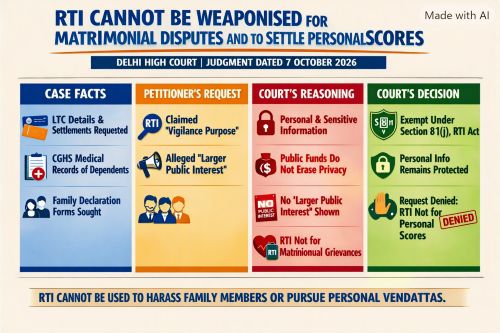
RTI Cannot Weaponised for Matrimonial Disputes & Personal Scores
Judgment dated 7.10.2026 of the High Court of Delhi in Writ Petition (Civil) No.9118 of 2025 of Sachin Kumar Daksh Vs. Director Admin and Finance and another
By the application dated 24.6.2024, the petitioner had sought the details of DGCA employee in respect of his (i) LTC with LTC settlement form, LTC tickets booked for each of the dependents and the final LTC Settlement, (ii) CGHS medical facility availed by the employee and (iii) Family declaration forms.
The said application was rejected since the information was covered by the Rule 8(j) of the RTI Act holding that the information sought constituted third-party personal information exempt from disclosure under Section 8(1)(j) of the RTI Act and that no “larger public interest” warranting disclosure had been established by the Petitioner.
In the present case, a perusal of the RTI application demonstrates that the Petitioner has sought, inter alia, details of LTC availed by the concerned employee with his dependents, the LTC tickets booked for each dependent, final settlement details, details of CGHS medical facilities availed by each dependent since the joining of the employee, medical bills pertaining to respective hospitals or clinics, family declaration forms submitted by the employee in respect of his dependents, and details of other LTC journeys undertaken with such dependents.
The information thus sought is not confined to an aggregate figure representing expenditure incurred by the DGCA on account of Page 3 of 5 W.P.(C) 9118/2025 LTC or medical reimbursement. It seeks information pertaining to identifiable family members and their travel, medical treatment, medical expenditure and the family declarations furnished by the employee in relation thereto. In the factual context of the present case, such information, by its very nature, concerns the private affairs of the concerned employee and more significantly, of his family members who are third parties and are not before this Court. The fact that some expenditure may have been reimbursed from public funds does not, by itself, result in the personal particulars connected with such expenditure ceasing to constitute personal information. Thus, it had been rightly held by the three competent authorities that the information sought relates to the personal affairs of third parties and is covered under the exemption stipulated in Section 8 (1)(j) of the RTI Act.
merely stating that the benefits in question may have involved expenditure from public funds cannot not, by itself, render the underlying personal information liable to disclosure, that too when the Petitioner has not demonstrated any overriding larger public interest which would warrant disclosure of the personal information of the concerned employee and his family members.
- Insofar as the contention of the Petitioner, that he is seeking the above information to pursue vigilance complaints, is concerned, the same cannot, by itself, create an independent right to access information which is otherwise exempted/protected.
Notably, it has also been pointed out by the learned Counsel for the Respondent that the Petitioner was married to the sister of Mr. Page 4 of 5 W.P.(C) 9118/2025 Komal Prasad and that matrimonial disputes have since arisen between the parties, with divorce proceedings having been initiated. It was thus submitted that the present RTI application has been filed with a pre-determined intent arising out of the personal dispute between the parties, and is not a bona fide attempt to seek information in any larger public interest.
- In this backdrop, this Court is also mindful that the RTI mechanism cannot be permitted to become a means to settle personal scores or to pursue grievances arising out of matrimonial disputes, particularly when the information sought pertains to the personal affairs of a third party.