
Pharma Marketing Practices Under Judicial Lens of Supreme Court
Pharma Marketing Ethics Under Judicial Lens of Supreme Court
Supreme Court Mandates Ethical Overhaul of Pharma Marketing Practices
Uniform Code of Pharmaceutical Marketing Practices
Order dated 8.10.2026 of the Supreme Court in Writ Petition (Civil) No.323 of 2021 of Federation of Medical & Sales Representatives Association of India and others Vs. Union of India and others
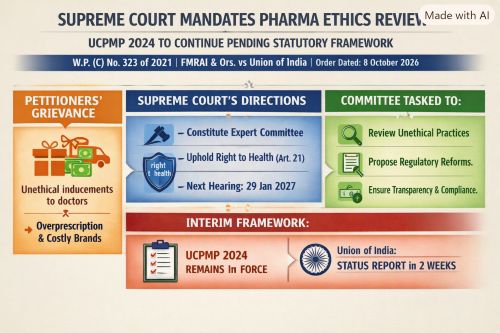
The principal grievance of the petitioners is with regard to the alleged prevalence of unethical marketing and promotional practices adopted by pharmaceutical companies in their dealings with healthcare professionals. The petitioners have set up a case that such practices include, inter alia, direct or indirect monetary benefits, gifts, hospitality, sponsored travel, entertainment and other inducements extended to medical practitioners with a view to influencing their drug prescribing practices. According to the petitioners, such practices have the potential to result in over-prescription or irrational prescription of medicines, prescription of drugs in excess of therapeutic requirements, prescription of irrational combinations of medicines and a preference for high-valued or over-priced branded medicines.
So far as medical professionals are concerned, the affidavit places reliance upon the existing statutory and regulatory framework governing professional misconduct, particularly the Indian Medical Council (Professional Conduct, Etiquette and Ethics) Regulations, 2002. Regulation 6.8.1 places restrictions on the acceptance of gifts, travel facilities, hospitality and cash or monetary grants by medical practitioners from the pharmaceutical and allied healthcare industry, while permitting bona fide medical research subject to the prescribed safeguards. The said framework further regulates the professional affiliations of medical practitioners with the pharmaceutical industry and prohibits them from endorsing drugs or products of the industry, subject to the requirements prescribed therein. Violation of these provisions attracts disciplinary action, including censure and, in appropriate cases, removal of the name of the medical practitioner from the Indian Medical Register or State Medical Register for the period prescribed under the Regulations.
As regards the pharmaceutical industry, the affidavit records that the Government proposes to constitute a three-member Committee to examine the issues arising in the present proceedings and to make recommendations as to the appropriate statutory and regulatory framework for regulating the conduct of pharmaceutical companies, particularly to ensure that such companies do not indulge in unethical practices in their dealings with medical practitioners. The Committee is intended to consider the existing regulatory mechanisms, the need for greater transparency and accountability, and the measures required to strengthen enforcement, and to place its recommendations before the Government for appropriate action. In the meantime, and until the recommendations of the Committee are considered and acted upon by the Government, the existing Uniform Code for Pharmaceutical Marketing Practices, 2024 (UCPMP, 2024) shall continue to govern pharmaceutical marketing practices.
At the outset, this Court considers it appropriate to observe that the issues arising in the present proceedings are of considerable public importance. The matter concerns the adequacy of the existing statutory and regulatory framework governing pharmaceutical marketing practices and the mechanisms for their implementation, monitoring and enforcement. This Court is, therefore, called upon to examine whether the existing framework adequately addresses the concerns relating to ethical practices, transparency and accountability in the pharmaceutical sector, while keeping in view the larger public interest in accessible and affordable healthcare.
The Committee so constituted shall undertake a holistic and comprehensive examination of all issues relating to unethical pharmaceutical marketing practices, including the adequacy of the existing statutory and regulatory framework, the efficacy of the mechanisms presently in place for monitoring, oversight and enforcement, and the measures required to ensure greater transparency, accountability and effective compliance, with a view to strengthening the regulatory framework and safeguarding the larger public interest.
The Union of India shall, upon receipt of the recommendations of the Committee, duly consider the same and take an appropriate and reasoned decision at the earliest, having regard to the constitutional mandate under Article 21 of the Constitution of India and the larger public interest involved in ensuring ethical, transparent and accountable pharmaceutical marketing practices