
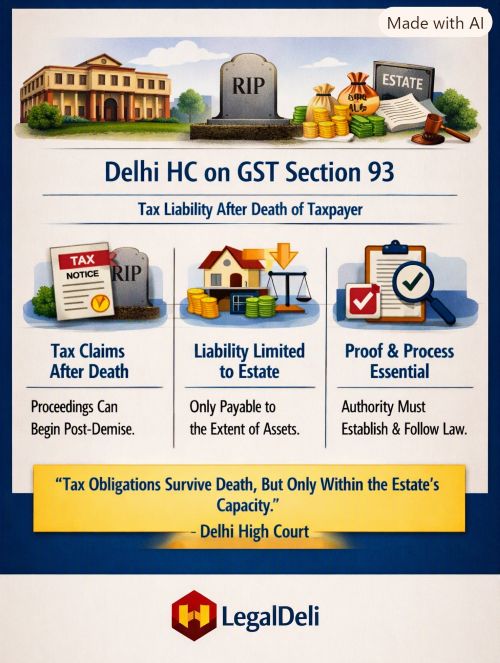
Delhi HC – Section 93 CGST Act proceedings against legal heirs
More than three years after the Petitioner’s husband died, the Department issued a Show Cause Notice1 to the Petitioner proposing penalties for acts allegedly committed by him during his lifetime. Through the present Writ Petition, the Petitioner challenges that Notice and the Order-in-Original passed pursuant to it, insofar as they proceed against her. 2. Section 93 of the Central Goods and Services Tax Act, 20172 provides for tax, interest or penalty being “determined after his death”. The question is whether those words permit proceedings to be commenced after death, or only the completion of proceedings already commenced during the deceased‟s lifetime. 3. For the reasons that follow, this Court holds that Section 93 does permit proceedings to be commenced after death, provided the conditions prescribed by the provision are satisfied. Whether those conditions were satisfied when the Department proceeded against the Petitioner is a separate matter and does not depend on the existence of the statutory power under Section 93 of the Act.
In the search of residence of husband of the petitioner on 23.7.2020, the cash of Rs.15,40,000/- was found. It was voluntarily submitted by him to the Department till completion of the investigation. The said amount was kept in fixed deposit in SBI.
The husband of the petitioner died on 6.5.2021. This was informed to the GST department vide letter dated 5.10.2021.
On 31.7.2024, the show cause notices were issued to several persons including the petitioner.
Section 93 provides that where a person, liable to pay tax, interest or penalty, dies, then his legal representative shall be liable to pay out of the estate of the deceased irrespective of whether such tax, interest or penalty has been determined after his death.
penalty in certain cases.—(1) Save as otherwise provided in the Insolvency and Bankruptcy Code, 2016 (31 of 2016), where a person, liable to pay tax, interest or penalty under this Act, dies , then–– (a) if a business carried on by the person is continued after his death by his legal representative or any other person, such legal representative or other person, shall be liable to pay tax, interest or penalty due from such person under this Act; and (b) if the business carried on by the person is discontinued, whether before or after his death, his legal representative shall be liable to pay, out of the estate of the deceased , to the extent to which the estate is capable of meeting the charge, the tax, interest or penalty due from such person under this Act, whether such tax, interest or penalty has been determined before his death but has remained unpaid or is determined after his death. ”
The provision preserves liabilities attributable to the deceased‟s lifetime conduct for lawful determination and satisfaction from his estate. Death creates the need for someone to represent that estate. The resulting distinction bears a direct relation to the statutory purpose. Section 93 does not deem the representative to have committed the alleged wrong, and clause (b) confines payment to the estate‟s capacity to meet the charge. The underlying contravention and the conditions of representative liability must still be established by the Adjudicating Authority.
Judgment dated 25.9.2026 of the High Court of Delhi in W.P. (Civil) No.7254 of 2025 of Jaiwanti Vs. Union of India and others