
Delhi HC – Medical Board Cannot Review and Reduce UDID Disability
Judgment dated 24.9.2026 of the High Court of Delhi in Writ Petition (Civil) No.12368 of 2026 of Asshiya Vs. National medical Commission through its Secretary and others with connected writ petition.
MBBS – NEET (UG) 2026 – PwBD Reservation – UDID & functional competence for admission
The petitioner in W.P.(C) 12499/2026 is an 18-year-old candidate with a permanent visual disability. By a Disability Certificate dated 28.12.2024, the Department of Empowerment of Persons with Disabilities, Ministry of Social Justice and Empowerment, Government of India, certified his permanent disability at 60%. A UDID card of the same date was issued to him recording the disability and its extent. However, Medical Assessment Board has assessed the disability at 30% for medical course admission.
In W.P.(C) 12368/2026, the petitioner has a permanent locomotor disability of 61%, recorded in a Disability Certificate and UDID card dated 11.06.2022 issued by the Issuing Medical Authority, North East, Delhi. She appeared in NEET (UG) 2026 under the General-PwBD category and secured 363 out of 720 marks (81.18 percentile), with a PwBD rank of 638. The Primary Disability Assessment Medical Board re-quantified her disability at 16% on 05.08.2026 and declared her ineligible for PwBD reservation.
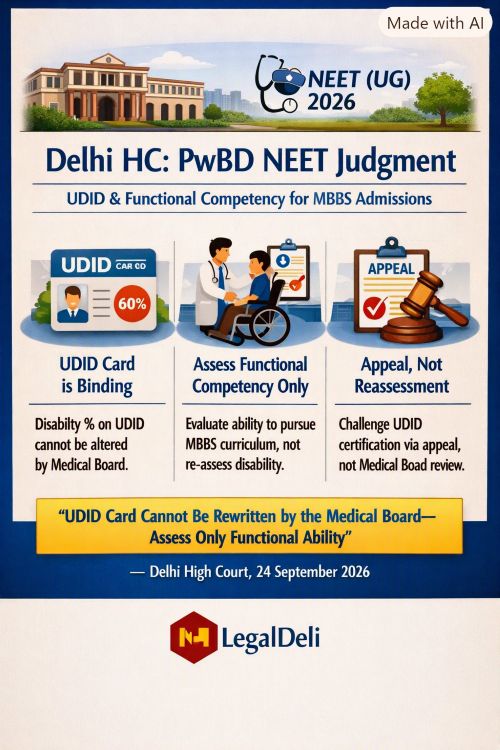
HELD that the Medical Assessment Board has no power to reduce the deniability certified in the UDID. The Board has only to consider and certify the functional competence of the PwBD students for admission to the MBBS course.
The Clause 3.9 of the guidelines on assessment of persons with benchmark disabilities for admission to MBBS Course, 2026 dated 27.07.2026 say “3.9 “Functional Competency” means the demonstrated ability of a candidate, with or without reasonable accommodation or assistive technology, to acquire and perform the essential competencies required under the Competency Based Medical Education curriculum.”
A combined reading of these provisions shows that eligibility for reservation under the PwBD category is determined by the benchmark disability prescribed under the Rights of Persons with Disabilities Act, 2016 (“the RPwD Act”). The UDID card issued under the Act is therefore the primary document for that purpose. 18. Clauses 9.2 and 9.3 of the Guidelines permit the Medical Assessment Board to assess a candidate’s functional competency, that is, whether the candidate can complete the MBBS curriculum and thereafter undertake the profession of medicine. They do not empower the Board to revisit the percentage of disability recorded in the UDID card.
These provisions show that the UDID card has primacy. If any of the respondents is aggrieved by the UDID card, the remedy is to appeal against the decision of the certifying authority. It is not open to a Medical Assessment Board to disregard or reduce the recorded percentage at the stage of admission. The same is also contained in the rule, 17, 18 and 19 of the Rights of Persons with Disabilities Rules, 2017.
A perusal of the aforesaid Rules, Sections and the Judgment clearly show that the role of the Medical Assessment Board is only to consider the functional competency of a candidate and not to interfere with the percentage given in the UDID card. If the same is permitted, then the UDID card issued, by the authorities will become mere paper formalities and would be meaningless. The same is not the mandate of the RPwD Act.