
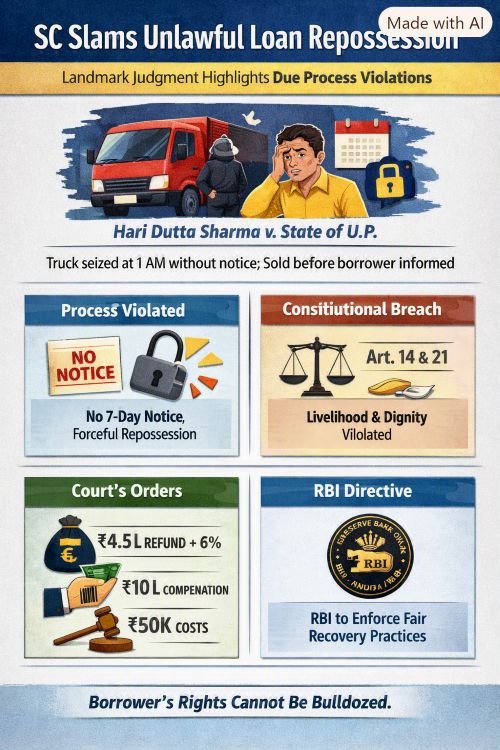
SC Slams Unlawful Repossession of Loan Truck in the Midnight by NBFC
Judgment dated 16.9.2026 of the Supreme Court in Diary No.10952 of 2026 of Hari Dutta Sharma Vs. State of U.P. and others.
A loan may create a debt, and a debt may confer upon the financier a right to recover what is due; but the manner in which that right is exercised is not without significance. The present appeal brings before this Court the contest between the right to recover a secured debt and the right of the borrower to have that recovery undertaken within the bounds of law.
On 25.03.2019, the appellant obtained a commercial vehicle loan 1 from Cholamandalam Investment and Finance Company Limited (the Company) for his truck.
Out of the sanctioned amount of loan of Rs.10,40,080.75 ps, a sum of Rs.9,36,000/- was disbursed. The amount of loan was to be repaid in 75 monthly instalments, and was secured by hypothecation of the vehicle.
On 12.06.2021, a further sum of Rs.1,04,080.75 was extended as a supplementary loan. \
The appellant failed to honour the repayment commitments and did not pay the amount of instalments due under the loan agreement.
On 09.04.2023, while the vehicle stood parked after making delivery of goods at a consignor’s godown under CCTV surveillance at Ayodhya, four unidentified persons broke the vehicle’s steering lock at about 1:00 a.m. and drove it away. The vehicle was repossessed without issuing any notice to the appellant. The appellant lodged a lost article Report and an e FIR on the same day. No action was taken on the complaint of the appellant for tracking the said vehicle. The appellant thereupon submitted a complaint on 08.09.2023 to the Superintendent of Police, Ayodhya.
On 30.09.2023, the appellant received a legal notice from the Company disclosing that since the appellant had failed to make repayment of the amount of loan due, the possession of the vehicle has been taken and the same has been sold on 31.08.2023. It was further stated that the sale proceeds were adjusted against the loan amount and the appellant was required to pay balance amount.
Turning to the facts, the action taken against the appellant is shown to be in contravention both RBI Guidelines, which carry statutory force, and of the very terms of Article 11 on which the Company relies. No seven-day notice, as contemplated by Article 11(a)(i), was in fact issued to the appellant prior to repossession; the right of repossession, being conditional upon such notice, never accrued to the Company in the first place. The appellant’s specific and unrebutted case is that possession was taken at about 1:00 a.m. on 09.04.2023 by breaking open the steering lock of the vehicle, a mode of taking possession that is, by no stretch, peaceful, and one which bears every mark of the very ‘goonda ism’ that this Court, in Prakash Kaur (supra), and the RBI, in its successive Guidelines, have condemned in unambiguous terms. The possession memorandum does not even bear the appellant’s signature which reinforces the conclusion that the vehicle was taken by the Company’s recovery agents without following the due process of law.
Financial institutions, particularly those operating under the regulatory umbrella of the RBI, hold their repossession clauses on the implicit condition that they will be exercised within the four corners of the procedural safeguards, the RBI has, over two 21 decades, painstakingly, built, notice, an opportunity to cure, a fair mode of taking possession, and a transparent mode of sale. Where a financier steps outside that framework, breaks open a lock in the dead of night, takes possession without notice and without a signed memorandum, and thereafter treats the borrower merely as a source of residual liability, it forfeits the protection that the contract and the law would otherwise have afforded it, and exposes itself to the consequences in law of an unauthorised and arbitrary seizure. It is the balance discussed earlier in this judgment, between the legitimate need of the financier for an efficient recovery mechanism and the equally legitimate entitlement of the borrower to be treated fairly, with notice and due process, before he is deprived of the very asset by which he earns his bread, that the Company failed to observe on the facts before us. 29. For the foregoing reasons, impugned order dated 04.04.2025 passed by the High Court is quashed and set aside. The vehicle of the appellant has already been sold on 31.08.2023. Therefore, even though we do not approve of the unauthorised and arbitrary action of the Company in repossessing the vehicle and in selling the same, at this point of time, we are not inclined to set aside the sale. 22 30. The appellant is a man of modest means and was solely dependent on the vehicle for his livelihood by engaging it in the business of transportation. The appellant has been deprived of his right to livelihood in an arbitrary and an unfair manner. The impugned action of the Company constitutes a violation of Articles 14 and 21 of the Constitution. Therefore, the appellant is entitled to compensation. 31. The Guidelines/Master Circulars/Clarifications issued by RBI to NBFCs and Scheduled Commercial Banks have existed only on paper, and no steps have been taken by the RBI to implement it. We, therefore, direct the RBI to take effective steps to secure genuine compliance, by NBFCs and Scheduled Commercial Banks alike, with the Guidelines/Master Circulars /Clarifications, it has issued from time to time, so that incidents of the present kind, where a citizen is dispossessed of his livelihood in the dead of night, without notice and without recourse, do not recur. The Registry is directed to send a copy of this judgment to RBI.
We, therefore, direct the RBI to take effective steps to secure genuine compliance, by NBFCs and Scheduled Commercial Banks alike, with the Guidelines/Master Circulars /Clarifications, it has issued from time to time, so that incidents of the present kind, where a citizen is dispossessed of his livelihood in the dead of night, without notice and without recourse, do not recur. The Registry is directed to send a copy of this judgment to RBI.
We, therefore, issue following directions: (i) The company shall close both the loan accounts of the appellant. 23 (ii) The Company shall refund the sum of Rs. 4,50,000/- (Rupees Four Lakh Fifty Thousand only) that is the sale price for which the vehicle of the appellant was sold. The said amount shall carry interest at the rate of 6% per annum from the date of sale till the payment is made to the appellant. (iii) The appellant is held entitled to a sum of Rs.10,00,000/- as compensation in lieu of mental agony caused to him and loss of his livelihood for a considerable period. 33. In the result, the appeal is allowed with costs which are quantified at Rs. 50,000/-.