Remarriage of widow does not extinguish Daughter’s Coparcenary Right
Judgment dated 25.8.2026 of the Madras High Court in CRP No.3576 of 2023 and CMP No.22376 of 2023 of K. Duraisamy Vs. Dhanalakshmi died and others
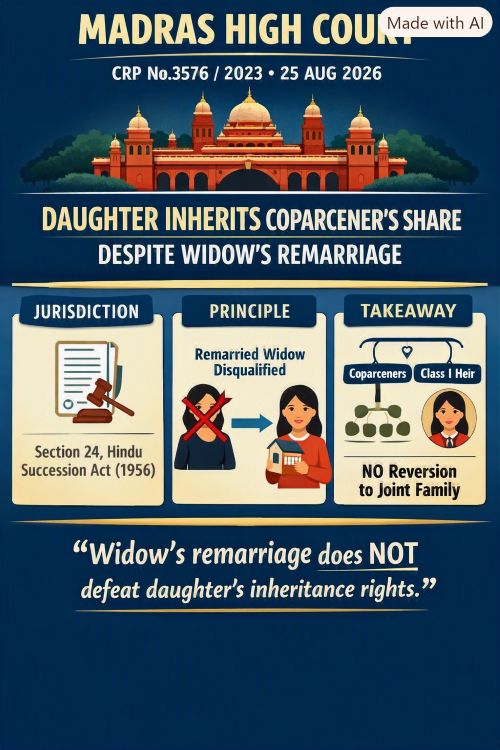
The short, but interesting point that arises for consideration in the present revision is as to whether the share of the deceased coparcener/son would go back to the other coparceners, when his wife had chosen to remarry after his demise or whether the daughter of the deceased coparcener son would inherit the entire share of the said deceased coparcener.
Admittedly, it is not in dispute in the facts of the present case that the estate opened prior to Act 39 of 2005, which omitted Section 24 disentitling a widow to any share consequent to remarriage. It is also not in dispute in the facts of the present case that the widow of the deceased coparcener remarried and therefore, she is not entitled to a share in her former husband’s estate.
The relevant Section 24 of the Hindu Succession Act, 1956 as it stood before the Amendment Act 39 of 2005 is as follows: “Certain widows remarrying may not inherit as widows. Any heir who is related to an intestate as the widow of a pre-deceased son, the widow of a per-deceased son of a pre-deceased son or the widow of a brother shall not be entitled to succeed to the property of the intestate as such widow, if on the date the succession opens, she has remarried.” 10. As already discussed in the opening paragraphs of this order, there is no quarrel with regard to the factual position in this case. The widow of Venkatesan, remarried and she never chose to stake any claim in the estate of Venkatesan. The entire share of Venkatesan was allotted to his only daughter and Class I legal heir, the 5th respondent, who took the entire entitlement and also alienated the suit property. It is at that juncture, belatedly that the 4th defendant attempted to execute the decree in OS No. 91 of 1993, contending that since the widow of Venkatesan had remarried and applying the then prevailing Section 24, her rights being forfeited, the share of the deceased coparcener, Venkatesan would revert back and enlarge the existing shares of the other coparceners. 11. In Vellikannu’s case (referred herein supra), the Hon’ble Supreme Court confirmed the view of the High Court that the widow of a coparcener cannot claim any share in view of proviso to Section 6 of the Hindu Succession Act, 1956 and, property being coparcenary property, she was entitled to a half share so long as the deceased father and son had not partitioned the property. However, on facts, it is to be noticed that it was a case where the disqualification of the coparcener deceased son was on account of the son having murdered his own father. It is in this context that the Hon’ble Supreme Court, discussed the relevant provisions namely Sections 25 and 27 of the Hindu Succession Act, 1956 and held that the son himself having become disentitled to any share in the coparcener property, his wife cannot claim any right or share in the said coparcenary property. I am unable to see how this ratio can be applied to the facts of the present case. Admittedly, this case does not involve Section 25 in the first place. Section 25 deals with a coparcener becoming disentitled to a share when he commits murder of his father, through whom he becomes entitled to a right in the property. It is in this context that the Hon’ble Supreme Court held that the son is treated to be a non-existent entity and therefore nobody can claim right under him, including his widow.
- However, the facts of the present case have nothing to do with Section 25 but only with Section 24. Even a cursory glance of the above provision only indicates that a widow of a pre-deceased son or a widow of a brother are not entitled to succeed to the property of an intestate, if such widow on the date of succession opening, has remarried. The coparcenary interest of the pre-deceased son does not get extinguished unlike Section 25 and continues to be available to be taken by the other preferential Class 1 legal heirs, say the mother or children of the pre-deceased son. The widow, as already discussed, is not claiming any entitlement in the present case. The embargo is only on the widow and not on other legal heirs to succeed to the estate of the pre-deceased son. The present case being the only Class I legal heirs, the 5th respondent, daughter of Venkatesan has inherited his entire coparcenary interest on his demise and as already pointed out she has already dealt with the property and third-party interest has flown. In view of the above, I am unable to countenance the arguments of the learned counsel for the petitioner that on the remarriage of the widow, the entire coparcenary interest of the son Venkatesan would revert back to the other coparceners and none of the Class I legal heirs including the daughter can claim right under the said deceased Venkatesan.
For various reasons discussed herein above, the judgment of the Hon’ble Supreme Court relating to a totally different factual matrix, where Section 25 and not Section 24 of the Hindu Succession Act, 1956 was involved, I do not see how this decision can be applied to the facts of the present case.
14. In such view of the mater, I do not see any error committed by the Subordinate Court in refusing to entertain the Execution Petition filed by the 4th defendant and I find no merit in this revision. Accordingly, this Civil Revision Petition is dismissed.